Posts Tagged “ psychopathy ”

Written by Gabriela Segura, MD
Sunday, 18 July 2010 03:47

The 1956 film “The Bad Seed.”

“I know now, so there’s no sense in lying any more,” said Mrs. Penmark to her daughter Rhoda. “You hit him with the shoe: that’s how those half-moon marks got on his forehead and hands.”

Rhoda moved off slowly, an expression of patient bafflement in her eyes; then, throwing herself on the sofa, she buried her face in a pillow and wept plaintively, peering up at her mother through her laced fingers. But the performance was not at all convincing, and Christine looked back at her child with a new, dispassionate interest, and thought, “She’s an amateur so far; but she’s improving day by day. She’s perfecting her act. In a few years, her act won’t seem corny at all.It’ll be most convincing then, I’m sure.” -William March, The Bad Seed.

Psychologist Robert Hare is devoted to the study of psychopathy. His research may upset a lot of people because until the psychopath came into focus, it was possible to believe that bad people were just good people with bad parents or childhood trauma. But Hare’s research suggested that some people behaved badly even when there had been no early trauma nor bad parenting. Moreover, since psychopaths’ brains are in fundamental ways different from ours, talking them into being like us might not be easy. Indeed, to this day, no one has found a way to do so (more information at hare.org).

For to many people the very idea of psychopathy in childhood is inconceivable. [...] Many people feel uncomfortable applying the term psychopath to children. They cite ethical and practical problems with pinning what amounts to a pejorative label on a youngster. But clinical experience and empirical research clearly indicate that the raw materials of the disorder can and do exist in children. Psychopathy does not suddenly spring, unannounced, into existence into adulthood. [...]

Clinical and anecdotal evidence indicates that most parents of children later diagnosed as psychopaths were painfully aware that something was seriously wrong even before the child started school. Although all children begin their development unrestrained by social boundaries, certain children remain stubbornly immune to socializing pressures. They are inexplicably “different” from normal children – more difficult, willful, aggressive, and deceitful; harder to “relate to” or get close to; less she puts on her sweet and contrite act we’re generally tormented by her behavior. She’s truant, sexually active, and always trying to steal money from my purse.”  – Robert Hare, Without Conscience: The Disturbing World of the Psychopaths Among Us

Dr. Richard A. Friedman is a professor of psychiatry at Weill Cornell Medical College in Manhattan. He recently wrote this article which is also food for thought:

Accepting That Good Parents May Plant Bad Seeds

Richard A. Friedman, M.D.
NYTimes.com
July 12, 2010

Gracia Lam

Gracia Lam

“I don’t know what I’ve done wrong,” the patient told me.

She was an intelligent and articulate woman in her early 40s who came to see me for depression and anxiety. In discussing the stresses she faced, it was clear that her teenage son had been front and center for many years.

When he was growing up, she explained, he fought frequently with other children, had few close friends, and had a reputation for being mean. She always hoped he would change, but now that he was almost 17, she had a sinking feeling. Read more…

Written by Gabriela Segura, MD
Monday, 9 March 2009 18:11

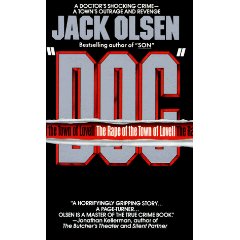
I walked into a bookstore of a small Canadian town in 2005 and asked for a true crime story where a doctor was involved. I thought that perhaps it would help me to understand better pathological personalities and how insidious they are in our society, including the medical community. A few seconds later the guy brought me, Doc: The Rape of the Town of Lovell by Jack Olsen, which won the 1990 Edgar Award for Best Fact Crime.

It took me other 4 years before I read the book, but I’m SO glad I finally did. It turned out to be most instructive regarding the insidiousness, subtleness and evilness of psychopathy. Jack Olsen knew about psychopathy which makes this true crime novel even more interesting. In fact he quotes The Mask of Sanity by Hervey Cleckley, M.D., an authority reference book of psychopathy in the fields of psychiatry and psychology. Olsen is able to give an incredible insight about how Dr. John Story, the psychopath doctor, raped numerous women in the town of Lovell in Wyoming for over 25 years without anybody doing anything about it. And even when some people knew about Dr. Story’s behavior (including hundreds or even thousands of victims), they only helped to conceal his behavior with their religious and societal programming.

Lovell is a small town in Wyoming whose population is about 50% Mormon. The victims were very religious and most of them consider themselves property of men, or the Church. Dr. John Story established his medical practice in Lovell in 1958 and he raped his victims while doing pelvic exams. The doctor, who was a pillar of the Baptist Church, enjoyed enormous prestige and support.

Read more…